Showing posts with label Physical Therapist. Show all posts

Friday, September 18, 2015

How to get the most out of physical therapy

This may surprise you, but lately I’ve had patients that come for therapy and seem like they are just fulfilling a requirement. They have minimal questions, one word answers and frequently ask how much longer until they are better.  Maybe they have had bad experiences in the past, or have lost hope of getting better.  But with everything in life, whether its work, fitness, or relationships, we get the most out of things we put time and effort into. Physical therapy is the same.

I thought it might be helpful to give a physical therapist’s honest perspective on how you as a patient can be sure to get the most out of your physical therapy sessions. First, it’s important to want to get better, and to prepare mentally for the likelihood that it will take time and patience to get there. You should be ready to put in the time needed for appointments and a home program. Also, part of wanting to get better is being flexible and open to limiting or changing current workout regime if needed.

Secondly, ask questions! Ask why you are doing specific exercises or why your therapist is using a specific manual technique on you. This is a great way to be involved and learn about your body. After all, this is YOUR body and you only have one! You can also do your own research on the web and ask us questions about what you find.

Lastly, be honest from the start. If you can only make 3 sessions or there is no way your life can go on if you have to quit running then tell us. Open communication is a key part of a patient-therapist relationship. We can be flexible too. If you can only make 3 sessions instead of 10 sessions, there is a big difference in what your therapist might spend their time doing during your sessions.

I enjoy being a physical therapist because of the relationships I build with my patients and the opportunity it gives me to help and motivate patients. These things work so much better when patients are ready and willing to be active participants in the rehabilitation process.


Candice Amat, PT, DPT
candice@duffyandbracken.com

Tuesday, March 31, 2015

The Power of Manual Therapy

Physical Therapists (PTs) use a number of different strategies to help restore an ailing client’s functionality. The three most popular restorative propellers are: manual techniques, modalities, and exercises. These three treatment resources are commonly combined into some fashion that aide in physical rehabilitation. As a passionate physical therapist, certain distinct things being practiced often bother me. For starters, it BLOWS my mind when a new client comes into my office for an evaluation with me, and tells me that they were treated in a previous PT facility that did little to no manual therapy. It also BLOWS my mind when referring medical doctors (MD’s) have prior conversations with patients strongly advocating the use of modalities as a major component in restoring functionality. Great… Thanks to that and their status on the hierarchy of the medical system, a nescient patient is now brain-washed into believing a passive, non-cerebral object is going to bring him/her to fame. Furthermore, I now have the pleasurable responsibility to try to convince otherwise; which, is more often than not, an impossible task. Concisely, manual therapy (hands-on treatment) is the driving force behind healing in physical rehabilitation. Simple.

Before I indulge in discussion about the preeminence of manual techniques, let’s define the term. Manual therapy can be defined as all the hands-on techniques that help reduce pain, increase mobility, increase muscle firing, increase strength, facilitate movement, increase function, decrease edema and/or reset or re-align anatomical segments. These techniques are provided by healthcare professionals in rehab such as: physical therapists, occupational therapists, chiropractors, osteopaths and the like. Manual therapy techniques include: joint mobilizations, soft tissue manipulations, deep tissue massages, rolfing, passive muscle stretching, muscle energy techniques, and proprioceptive neuromuscular facilitation to name a few. There are multiple reasons for the administration of manual treatment; moreover, the importance of manual work with injured patients is extensive.

For starters, it allows for an objective feel of the soft or bony tissue by the treating clinician. Clinicians can get an overall assessment of the static quality of the palpated tissues, as well as, the dynamic quantity and quality of movement. Moreover, certain manual techniques can deliver soothing sensations, which help patients feel better and puts them at ease. Most importantly, manual therapy can shorten the injured party’s convalescence by directly targeting the problematic source. Manual techniques can help a client move better, move faster, and restore proper movement mechanics by increasing a patient’s range of motion in a specific joint.

On the other-hand, modalities are therapeutic agents, or machines mostly powered by electricity, that are designed to contribute to healing. These modalities include: electrical stimulation, moist heat, ice packs, ultrasound and the like. The inherent problem is that there is currently little to no scientific evidence in medical literature that advocate the rehabilitative efficacy of these said modalities.

Hands on techniques help develop a successful therapeutic relationship, which I’ll blog about on my next post. In my everyday practice, I employ hands-on techniques, and have developed great bonds with my clients. The fact of the matter is that the patient/client has to first trust you to allow you to touch them. It drives down insecurities and helps not only the physical rehabilitation process, but the never negligible mental rehabilitation process as well. Injury takes a toll on people’s body and psyche often equally. The warmness of your heart can be felt through your hands.


Bottom line: Passive modalities do NOT suffice. I know we are in the information age, and the trend is to believe that nearly all machines nowadays can take the place of humans, but this is not true for physical rehabilitation. For all patients and physical rehab clinicians out there, please know that the best way to tackle the issues head-on is hands-on.

 Clifford Civil, PT, DPT, ACSM-HFS


Tuesday, June 24, 2014

Pick The Right Stroller Without Obsessing!


For a new mom picking the right stroller can be overwhelming not to mention expensive. The sales pitch will have you deliberating between strollers of all shapes and sizes.


How do you choose between all the bells and whistles from smart phone to latte holders and various pockets that organize all your needs?

And of course, the price will leave you wondering if you have just been bamboozled. In the process of wanting the very best for our new bundles of joy, our real needs go out the window right along with our money. We forget that the practical aspects of our lifestyles and city living in particular, goes far beyond the new must have stroller or dream accessories.

To help you navigate through the wonderful world of strollers, here are 5 important things to remember when picking the right stroller.


  1. Usage: are you going to use the stroller on public transportation (subway or bus). If so, can you carry the stroller and baby up a flight of subway or bus stairs? Case in point: as much as we would love them to say small, babies get heavier over time and are unable to negotiate stairs until 18 months old.
  2. Ease of folding: can the stroller fold easily with baby in one hand. Remember as women we carry not just the stroller and baby but our pocketbook and/or diaper bag as well. 
  3. Height: if you and your partner have more than 6 inches in height difference does the stroller have adjustable handles.
  4. Footprint: how much space does a folded stroller occupy in closed quarters?
  5.  Maneuverability: can the stroller lock, unlock and make tight turns? Can wheels transition from pavement to grass?

When it comes to picking the right stroller use your heart as well as your head, you can always personalize your stroller to meet your unique style after making the smart functional choice! Need help picking the right products for you? Schedule an appointment for my P3 Method Pregnancy Program and we can do some custom shopping together.

Renuka Pinto, MPT, PGDR, CSCS, CES
Physical Therapist & P3 Pregnancy Program Creator
Duffy & Bracken Physical Therapy


Wednesday, May 28, 2014

Pregnancy Aches & Pains


Every pregnant woman dreads being a victim to pain! You can't pop any medications and if you really need some relief you can ONLY take Tylenol.

Why do we have to experience pain & discomfort during such a wonderful experience? 

So let's understand pain and pregnancy. During pregnancy our bodies change shape, that's because of a hormone called Relaxin that allows our joints and muscles to loosen up to accommodate the weight gain. Our breasts become larger, waists widen and hips become round. This increase in SIZE makes our muscles work harder.

In a nutshell, the pain and discomfort we feel just points to the structures and areas of our body that are being overloaded! Rather than getting alarmed or accepting pain, speak out and seek help. Your best bet is a physical therapist that can help you to alleviate pain through joint techniques and teach you stability exercises so your weak areas become strong.

At Duffy & Bracken we see at least six pregnant women per week with pain....with successful outcomes. We explain why that particular area hurts and then offer solutions to avoid undue stress.

Stay tuned for later blogs were I will cover how pregnancy affects individual areas like your spine, feet and pelvis in more detail.


Renuka Pinto, MPT, PGDR, CSCS, CES

Wednesday, April 30, 2014

Start This Spring Right: Be Active & Healthy!


With the weather getting warmer and more favorable to outdoor activity, this is a great time to start practicing healthy habits by being physically active. Physical Therapists prescribe exercises to address dysfunctions in an individual’s body. We rehabilitate patients from ailment or injury, as well as, give guidance on what patients should do to prevent a recurrence or new injury altogether by finding muscle imbalances and faulty movement patterns. Exercise can help eliminate or ease complaints of pain, restore normal biomechanical movement, and increase functional ability. A comprehensive exercise routine can help foster all the aforementioned with the method of payment being consistency!

Although doctor referred patients are given a prescription to seek Physical Therapy services, I believe for a majority of cases the patients' truest prescription for health is exercise! This theory also holds true for the general public including those with or without a disease or physical aliment. As a Health Care Provider, Physical Therapist and Health Fitness Specialist, it is my absolute duty to promote the medicinal benefits that a consistent exercise regimen presents. These benefits include decreasing the risk for coronary heart disease, stroke, and high blood pressure. Another important exercise-induced health benefit that directly relates to Orthopedic Physical Therapy (a sector of physical therapy practice at D&B) is the preservation of bone mass that comes along with consistent exercise. When bone mass is kept healthy, it negates or delays the potential for osteoarthritic conditions to flourish. Common osteoarthritic complaints in orthopedic physical therapy tend to be back pain, neck pain, knee pain, and shoulder pain. If your bones stay strong and healthy, your risk for joint pain decreases markedly.

Everyone can benefit from being physically active. For what it's worth, I practice what I preach and try to get others to follow my lead. Personally, I have created a fitness challenge for myself for the month of April, of which I perform some form of exercise for at least 30 minutes a day for each day in the 30-day month of April. I named the effort “#30four30.” 30 (30 minutes)---four ([for] The Month of April is 4, The 4th month of the Year)---30 (30 days).  I have gotten friends, family, and patients to join me on this journey. It's a great way to stay active, motivated, and to become and remain healthy.

At Duffy & Bracken we offer our patients programs that help them begin their fitness journey the right way and continue it without injury. Our GRAVITY Small-Group Personal Training classes offer a safe effective total body workout in just 30 minutes. It’s great for all ages and fitness levels. Invest in your health by starting your fitness challenge now! Get out there and exercise, now and forever! It's an inexpensive way to feel expensive! You're guaranteed to do a world for your mind, body, and pockets.

Clifford Civil, PT, DPT, ACSM-HFS


Monday, December 16, 2013

Building a Successful Therapeutic Relationship!


The patient-therapist relationship is vital to the success of the patients' plan of care. Although that theory may seem obvious, the value of a functional relationship between a PT and their patient is sometimes neglected whether consciously or unconsciously. Good service is invaluable!

So how do we develop this relationship?

Open Dialogue: From the initial evaluation all the way to discharge, therapists and their respective patients should be continuously discussing the progression of their therapeutic program. Therapists should be assessing what's giving positive results, no results, or negative results.

Education: Therapists should be consistently keeping their patients aware and engaged by educating them on what may be causing any symptoms, the plan to treat it, why they're doing what they're doing, and what to expect from it all. Being that a therapeutic program has time limitations, it's also quite essential and beneficial for the patient to be given lasting information to take from their care in order to be responsible for their health in the forthcoming days after they have been discharged.

Accountability: On the other hand, therapists are not the only takers to responsibility. Patients MUST be willing to trust in the therapist's creative plan, follow the therapist's guidance, and take the initiative to perform their Home Exercise Program (HEP) regularly. Patients should be open enough to tell therapists how they feel about their current treatment program. I ask my patients how they feel about their treatment at almost every subsequent appointment.

When there's a good communicative relationship between the two parties, it creates a larger potential for a successful therapeutic experience even if physical therapy is determined to not be the cure to their specific disorder. As a Physical Therapist, I think I can speak for a grand number of other therapists when I say we find gratification in gratifying. Personally, it serves as a humbling reward for a patient to express gratitude for how they were treated throughout the patients' tailored program. It is the fuel that keeps my wheels turning (or my hands mobilizing to keep things in perspective).


Clifford Civil, PT, DPT, ACSM-HFS
clifford@duffyandbracken.com

Monday, October 7, 2013

Great Expectations: How To Pick A Physical Therapist


As a physical therapist, all too often I have new patients come in who tell me that they’ve tried physical therapy in the past for six, seven, eight plus months, with basically nothing to show for it. The two questions I always ask these patients are: “What did they do with you?” and “Did you think that what they were doing was helping?” While I don’t expect patients to remember every detail of their PT regimens, they should be able to say with confidence whether or not they felt that PT helped them. For those of you reading this who can align yourselves with the plights of those poorly-served PT patients, I’d like to offer you these few pointers to help ensure that your next PT encounter doesn’t leave you feeling like all you’ve managed to accomplish is throwing a few dollars at that high insurance copay or deductible.

Your physical therapist should be:

1. Present – Your physical therapist should BE PRESENT. If your therapist is spending 5 minutes with you then passing you on to an aide or trainer never to be seen again, it’s time to look for a new physical therapist.

2. Hands-on – While physical therapy does emphasize exercise and therapeutic activities, the manual techniques employed by your therapist can greatly help accelerate your healing process or correct dysfunction that could lead to injury down the road. If the physical therapy that you’re used to centers around ultrasound, heat packs, and stim, (electrical stimulation) with the therapist basically spending three minutes giving you a bad massage, it’s time to look for a new physical therapist.

3. Approachable and Informative – Too scared to ask your therapist why they have given you a specific exercise or why they are using a specific manual technique? You shouldn’t be. While the busy schedule of a physical therapist does not afford them the opportunity to spend hours upon hours with each patient, a therapist should be both willing and able to answer any relevant questions asked (and not asked) by the patient, within the allotted time.

4. Creative – Don’t expect a poetry reading when you go to physical therapy, however, your physical therapist should be able to provide you some variety with your exercises and treatments. If you’re doing the same exact thing at every session, for weeks on end, with no progression and no improvement in your symptoms, it’s time to look for a new physical therapist.

5. Competent – It goes without saying that your therapist should know what they’re doing, however, it is important that you feel confident in their competency. I’m not advocating that you base your physical therapist selection on their pedigree or how many letters they have after their name, but the manner in which they explain things to you, the exercises they prescribe, and the manual techniques they perform should all instill confidence in you that they can help you achieve your goals and improve your symptoms.

Here at Duffy & Bracken each of the physical therapists on staff bring with them all of these characteristics, and many more. However, my intent is not to tout how much better our practice is than others out there. Let this blog simply serve as an informative piece for anyone who has been to PT, is currently attending PT, or is looking for a physical therapist and wants to ensure the quality of services being offered. 

It’s your body. It’s your health. Choose wisely!


C. Shante Cofield, PT, DPT, CSCS
Duffy & Bracken Physical Therapy and Wellness
Carmen@duffyandbracken.com

Monday, June 3, 2013

Help Us End The Unfair Practice of "Specialty Copays"


A Bill (S.2319/A.1666) put forth by The New York Physical Therapy Association (NYPTA) is on the current NY State Assembly agenda and we need your help to get it passed. The unfair practice of so-called "specialty" copays is costing patients in dollars and forgone treatment, leaving New York State with a more costly and less effective health care system. 

Managed care companies continue to restrict access to physical therapy services by imposing "specialty" copayments of $40-$50. As the patient you maybe paying $50, while your insurance company is paying the physical therapist $5 or $10. Managed care health insurers have designated physical therapists as specialists for copayment purposes, allowing health plans to charge patients more per visit while maintaining reimbursement levels to physical therapists at 1980's levels, shifting more of the cost burden onto the backs of consumers and pushing PT's near bankruptcy.

These specialty copayments add up for New Yorkers, since physical therapy frequently requires multiple visits over an extended period of time as the practice of physical therapy works in conjunction with the healing process. In 10 visits the patient may pay ($50 X 10) $500 while the insurer pays ($5 X 10) $50. You have a COPAY and they have a Nopay.                                       
The bottom line is this: HIGH COPAYS HURT PATIENTS

The bill is currently in committee and we need your help to move it along. Please call your NYS Legislator and tell them to stop high copays for physical therapy care and to support S.2319/A.1666. This will help end the imposition of additional copays on New Yorkers for physical therapy services.
Sincerely,

Ann Duffy, MA., P.T.
Owner, Duffy and Bracken Physical Therapy


 Ways You Can Help!  

Talking Points for High Co-Pay Legislation - S.2319/A.166

Find your NYS Legislator


Tuesday, May 21, 2013

ELIMINATE WORKPLACE ACHES & PAINS!


Please allow me to introduce myself, my name is Julie and I recently joined Duffy and Bracken, PT. I practiced as a physical therapist for 7 years in Seattle Washington before moving to Downtown NYC. One of my specialties in Seattle was workplace modification and 5-hour return to work testing. These included activities such as touring a sawmill to adjust a workstation to accommodate an injured shoulder patient to modifying the internal organization of a police car to accommodate a low back patient. While the average New Yorker I currently treat is not in an industrial occupation, workspace modification is no less important. You spend 8-10+ hours a day at your desk and the more efficiently you set it up, the less stress you will experience on your neck, back and arms.

Here is a little test – can you sit with your back straight and feet flat on the floor for 5 minutes without fidgeting or adjusting and without an increase in pain? If you cannot then your core musculature does not possess the endurance for an 8 hour day in a chair.

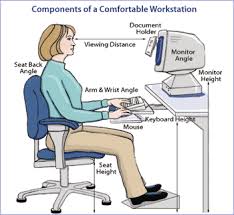
Ergonomics strives to keep your joints in a neutral position to minimize the stresses on the muscles and ligaments. People come in different sizes so no two desks should look alike. Here are some suggestions for easy adjustments to your desk:

Adjustable Chair
When you are sitting your knees should be bent at a 90-degree angle with your feet resting on the floor. If you are petite and can lower your desk this is ideal but most desks do not have modifiable heights. If your feet do not touch the floor, bring the floor up to your feet with a footrest or even a small box.

The end of your seat should reach to four finger lengths to the back of your knee. Any farther forward can pinch nerves in your leg and make it uncomfortable to sit. Legroom under your desk should be at least 60 cm to allow for easy foot movement.

The backrest should be adjusted so that there is a convex surface supporting your low back. (If your chair does not have this I would suggest an adjustable lumbar support, which we stock here at Duffy and Bracken).

The arm rests should be positioned so that your elbows are slightly forward and bent at near a 90-degree angle.
With Foot Rest
 I am asked a lot about therapy balls as chairs. While I think this is good for watching TV, spending 8 hours a day on a therapy ball requires a lot of core endurance. If you would like to sit on a ball at work I recommend keeping a chair nearby for when your back becomes fatigued.


Keyboard
When you are typing your wrist should be supported and your elbows should be at a 90-degree angle. Because your arm rests should also support you at a 90-degree elbow angle it sometimes comes in direct conflict with your keyboard. I would suggest table length arm rests (they are shorter and allow you to push your chair up to the desk) on your chair or none at all if you are mostly on the computer or writing while at your desk.

Mouse
A traditional mouse used to control your cursor can add increased stress on your arm and shoulder because you have to elevate your arm for long periods of time. I recommend a trackball mouse. Your hand rests on the mouse and your thumb moves a roller ball that controls the cursor. They are inexpensive and your neck and shoulder will thank you.

Computer Screen
When you sit upright at your desk your eyes should be level with the top line of your screen. It is much easier for your eyes to track inferiorly without affecting your neck posture than it is for your eyes to track superiorly. If your computer screen is too high we tend to push our head forward and angle our head upwards, which tightens the back upper neck musculature. This is a good time to walk around your office and see your co-worker’s computer posture.

If you have a laptop it is harder to modify. I suggest putting it on a pedestal to raise the screen up and buying a wireless keyboard. 
 
Divide Your Desk Into Angles
Items that you use constantly should be within a radius of 50 cm – which means you do not have to reach far or rotate your body to grab them.  Items you use less can be a short reach away. 
Standing Desks
If you do a lot of reading you can make yourself a standing station at your desk. The optimal reading angle is with a 45-degree slanted desk and if you are writing the optimal angle for your elbows is with a 15-degree slanted desk. 

Unslanted Desk
 
Breaks
Most importantly you need to get up and walk around to give your body breaks from being in one position. Most people become so engrossed in what they are doing that they forget so I propose setting your cell phone to go off every 1-2 hours. A 5-minute walk around your office will help clear your head and give your muscles a chance to relax.

If you have any further questions about how to modify your workstation or you want a professional to assess your sitting ability, please do not hesitate to see me here at Duffy and Bracken, PT.


Julie Garner, DPT, COMT, CCI