Monday, February 23, 2015

Battle Your Hormonal Shifts By Simply Breathing!

My mother was a wise woman who passed down self-help techniques to me, as her mother did to her. She was born in 1923 and her mother in 1903, in times with very little preventative care or self-help books available. One of the things I didn't quite understand was her advice during my menstrual cycle. She said things like don’t drink or touch plants while I had my menses because it wasn't good for the plants?? I'm not a horticulturist and I don't know if there is any validity to the plant thing but she was basically saying your body composition is different when you have your period. The plants know it and they don't like it. The drinking thing -- well that’s the last thing you need with everything going on.

It's incredible what women have to put up with. Think about it, we menstruate every month! That's 2,400 days over 40 years and that’s if it were only 5 days a month but this process seems to affect us all the time, in one way or another. When I asked my mother why, she told me the story of Adam and Eve. So, is it all Eve's fault? Well I thought I would explain a little more of what’s really going on in your body while you go through hormonal shifts and the lining of your uterus sheds.

In the first 14 days, estrogen levels are higher and there is a rise in carbon dioxide (CO2). Global warming is going on inside your body for 2 weeks a month! During the second 14 days, progesterone levels are higher and there is a decrease in CO2. So we're more oxygenated during this time and this can really turn on the gas and our super human powers. A quote from Ginger Rogers comes to mind, "I did everything that Fred Astaire did but backwards and with heels on." Give yourself a pat on the back and a break when you're not at your peak and power it on when you are!

So how does carbon dioxide affect us? CO2 determines the acidity in our body. All metabolic function is reliant on acid base balance. Increased CO2 affects the excitability of our nervous system. Our muscles are hyper-irritable, pupils dilate, extremities are cold and there is an increase in sweat. CO2 is regulated by breathing… so breathe! The loss of CO2 during hyperventilation and shallow breathing affects blood flow to the brain, hands and feet. Hyperventilation can also affect memory, digestion, absorption of food, coordination and ambulation .

So it’s no wonder you've been feeling like Dr. Jekyll and Mr. Hyde. Breathing can produce amazing results by relaxing us. It relaxes muscles and helps with pain particularly back pain. I have even breathed out Migraines and heard testimony from others who have done the same. It makes sense to practice this all the time especially during your menses. So now we know the importance of carbon dioxide and breathing, let’s learn how to breathe more effectively. Here are some breathing tips to help you relax.

You need to breath with your diaphragm. Imagine the rib cage being a barrel. The ribs are the sides and the diaphragm is the bottom. You can feel your diaphragm by pressing your fingers up into the bottom of the drum. As you breathe in, your diaphragm will lower and your belly will balloon and expand out. You should feel your breath expanding the sides of the drum all around- out your back, sides and front as your diaphragm drops and your abdomen expands. Your abdomen should be soft and relaxed so it can relax and expand as you breathe. Your pelvic floor muscle moves down with your diaphragm. Diaphragmatic breathing stimulates the parasympathetic portion of the nervous which will help calm down your muscles, nerves and you. Practice your breathing exercises every hour or anytime you need to calm your body or mind. 

Physical Therapists can teach you techniques to help you learn how to help yourself. Women are very powerful beings and we can heal ourselves if we give ourselves the right environment to do so. I encourage you to learn how and let a physical therapist help.


Ann Duffy, Owner & Women's Health PT
Duffy & Bracken, PT
ann@duffyandbrackne.com

Tuesday, January 27, 2015

Health Insurance 101

It never fails to amaze me when I hear a patient talking about how much they hate their current insurance policy. “They are horrible” “They pay nothing” “It’s such a waste of money” “It’s so expensive each month”. These are just a few of the things I hear almost on a daily basis. At the end of the day it is your money that goes into your healthcare so why not take charge when it comes time for you to choose your healthcare policy.

For many people health insurance is something that is only utilized when they become sick. So what do people do? They go the inexpensive route. I will admit I too would look at the cheapest offer first. But what exactly are you getting out of it? Cheap is not always better and when it comes to your health, it shouldn’t be.

In this entry I hope to offer you some advice on deciding which policy to switch to.

What kind of policy do you need? When looking for a policy there is a variety of things that you want within the plan. Keep in mind who it is for; yourself, your spouse, your children. What specialties do you visit often? Are emergency room visits a priority?

Education. HMO, PPO, POS. They aren’t just letters associated with health insurances; they mean something. Take the time to learn what they mean because when deciding on your future policy they can either help or hinder you.

Research companies. Take initiative and read about the different kinds of insurances that are out there. There are a huge variety of them with both pros and cons. All insurance companies are not the same and do not offer the same benefits. If they did, there wouldn’t be so many to choose from. Read, call, and question everything you do not understand. Educating yourself will help you gain knowledge.

Network Status. There is nothing worse than coming for years to your favorite primary care doctor or specialist, only to find that your new insurance plan is no longer in network. Be proactive and find out what insurance your favorite medical providers accept to help you decide on a policy.

Get familiar with your out-of-pocket expense. So many times a patient is shocked to hear their co-payment amounts or how high their deductible is. When you are looking at your policy options you can also learn beforehand what these amounts will be. Often times an individual sees that they may have a high deductible then covered at 100% at a small monthly fee. Although you are saving money the downside of this is you are walking into your medical appointment and being told that you are paying your deductible and this amount is $100 per visit. Trust me, this has happened before and it won’t happen to you if you know what you’re looking for and educate yourself.

​The whole insurance ordeal can be tricky but taking charge can put you in the right place so that you won’t get trapped in a low allowable visit amount or high deductible policy.

Von Petteway
Duffy & Bracken Verification Specialist
vonceia@duffyandbracken.com


Friday, November 7, 2014

Top 7 Reasons EVERY Woman Should See A Pelvic Floor Physical Therapist After Having A Baby

This likely doesn't come as a surprise to you, but when it comes to women's health, the US is pretty far behind the eight ball. While we do have extensive measures in place to help ensure a safe gestational period and delivery, our healthcare system does very little in the way of caring for women following childbirth. In fact, our society has virtually taken the opposite stance, writing off those post-partum pathologies as normal, or part of the territory, thereby convincing women that they don't actually need to seek medical guidance. This couldn't be further from the truth. 
Childbirth is an extremely traumatic event for a woman's body. During a vaginal delivery, the muscles of the pelvic floor are significantly stretched and can tear. Cesarean deliveries decrease tearing at the pelvic floor, however the muscles of the abdomen do not fare as well as they are cut and stretched to allow the baby to be retrieved. Let's also not forget the 40 weeks during which the pelvic floor muscles need to support the weight of that growing baby. 
Enter pelvic floor physical therapists. As explained on my website, TheMovementMaestro.com, a trained pelvic floor therapist is able to evaluate your pelvic floor via an internal and external exam and assess muscle function directly. Additionally, pelvic floor physical therapists understand the relationship between the pelvic floor and the rest of the body, therefore making them well-suited to identify how dysfunction at a different part of the body could cause pelvic floor dysfunction and vice-versa. 
More specifically regarding the aftermath of childbirth, pelvic floor physical therapists, unlike the doctors delivering your baby, are concerned with YOUR functionality, YOUR ability to return to all the tasks required of you on a daily basis, and getting you back to doing all the things that YOU enjoy doing. If I haven’t convinced you yet, here are 7 reasons why EVERY woman should meet with a pelvic floor physical therapist, even if it’s only once, after having a baby.
 1. You and your baby shouldn’t be in diapers at the same time.
Although urinary incontinence is common both during and following pregnancy, it is NOT normal. Most women will either be informed by a health care provider that incontinence will go away on its own and to not worry about it, or they will be welcomed into the sisterhood of mothers by a female relative or friend with the sage advice that incontinence is part of having a baby and to just accept it. The only truth regarding these statements is that every time one of these phrases is uttered, a kitten dies. Incontinence indicates pelvic floor dysfunction. While it may resolve over time without formal intervention, the pelvic floor generally remains weak and is working on reserve capacity. To that end, it's not uncommon to see this incontinence returning down the road or following subsequent deliveries. Additionally, urinary incontinence isn’t the only type of incontinence caused by a dysfunctional pelvic floor. Two words for you, ladies: fecal incontinence. Pelvic floor physical therapists treat both urinary and fecal incontinence, often achieving full resolution of symptoms. Save the Huggies for your kid and get in to see a pelvic floor PT.
 2. Sex isn’t supposed to hurt.
Tearing is a very real part of childbirth, with the aftermath being scarring and tightening of tissues of the pelvic floor. Additionally, hormonal changes can lead to vaginal dryness. A pelvic floor physical therapist can work with you to decrease scar tissues, loosen tight muscles, and give you helpful hints on how to get your groove back. 
 3. Your organs should remain on the inside of your body.
The trauma and weakening of tissues that is associated with carrying and delivering a baby can cause what is known as pelvic organ prolapse. In layman's terms, this is when your insides end up on the outside. A falling or sliding out of place of the vagina, uterus, urethra, or rectum can occur, and can vary in severity from slight descent where the organ remains inside the body, to full prolapse where your organs are resting on the treatment table. Google it. It's real. Pelvic floor therapists can not only identify and assess a prolapse (many women don't even know they have the early stages of this), but they can provide exercises to prevent or improve this condition. Hint: there's more to it than just kegels. 
 4. Your belly button should be the only "hole" in your belly. 
As the abdominal muscles stretch during pregnancy, a split can develop at the central connective tissue of your six-pack. This connective tissue is known as the linea alba, and when it separates, it is referred to as a diastasis (di-as-ta-ses) recti.  I'm not sure that I need to go into detail as to why having a hole in the middle of your abs is bad, but let's start the list with back pain, core weakness, and breathing dysfunction to name a few. Like incontinence, diastasis recti a very common occurrence, however, it's advisable that you meet with a pelvic floor therapist so s/he can asses the size of it  (in finger-widths) and recommend not only exercises to help it close, but movements and activities to avoid so as to prevent it from getting any bigger. 
 5. Walking and exercising shouldn’t make you feel like your pelvis is going to break into a million pieces.
Many women experience pelvic and low back pain during pregnancy secondary to hormone-related changes that cause laxity in the pelvic ring. Most women think that this pain will automatically go away once that 8lb baby is no longer inside of them. Fast forward a few months and these same women want to kill their partners for helping them get pregnant once they realize that childbirth does not magically rid them of all of their hip/pelvis/low back pain. Pelvic floor physical therapists can help...a lot. Soft tissue techniques, exercises, movement modifications, the list goes on and on. PTs can help with the pain and get you back to being you. 
 6. C-sections are no joke.
Far too often I hear women say they want to schedule a c-section and avoid the aftermath of a vaginally delivery. Clearly these women have never spoken to anyone who has actually had a C-section. The trauma experienced by the abdominals during a C-section is significant, and often renders a woman unable to do much of anything for a few weeks. Imagine having your abs and uterus cut open, your insides sifted through like a game of hide and seek, a 7lb baby pulled out through a 4-inch incision, and then everything sewed up. I really can’t imagine doing much more than blinking my eyes after something like that, nevermind coughing, sneezing, pooping, or taking care of a human life. Pelvic floor physical therapists help women deal with what comes after the c-section, from regaining abdominal strength to preventing back pain and scar adhesions in the future.
 7. Kegels don’t work if you do them wrong. 
I have plenty of moms coming into my office telling me how their incontinence never went away even though they tried doing kegels a couple of times. Here’s the deal: 1) If you’re not performing a kegel correctly, utilizing all the layers of the pelvic floor (wait… there’s more than one layer? More on this in upcoming posts), and getting a full 360 degree contraction, you’re squeezing in vain. 2) The pelvic floor works in conjunction with the rest of your ‘core’, and requires not only the participation of the rest of those muscles for proper functioning, but correct pelvic alignment. Long story short, there’s more to it than just kegels. Let a pelvic floor physical therapist assess your ability to perform a kegel and then instruct you on functional exercises to help facilitate normal pelvic floor function.
I realize that once you have a baby you have very little time to take care of you. That is even MORE of a reason to get in and see a pelvic floor PT. A therapist can and will work with you to educate you on things to avoid and empower you with the knowledge of how to TREAT YOURSELF. Additionally, most therapists are super understanding and are more than willing to having you bring in your baby with you if childcare is an issue. Pain, dysfunction, and wetting your pants does NOT have to be your reality following child birth. Pelvic floor physical therapists are here to help. To locate a pelvic floor physical therapist in your area click here.


C. Shante Cofield, PT, DPT, OCS, CSCS 
Shante@duffyandbracken.com


Wednesday, October 8, 2014

Part II: Hips Don't Lie

Last week I shared with you this piece highlighting the benefits of standing with your feet pointed straight ahead. This week we bring movement into the equation and discuss the merits of moving with those feet pointed straight ahead.
Image courtesy of RunnersWorld.com
IMAGE COURTESY OF RUNNERSWORLD.COM


Let’s start at the ground and work our way up. When we walk, the foot has a characteristic pattern in which it’s supposed to contact the ground. If you look at the bottom of someone’s shoe who has an ‘ideal’ stride, you’ll notice a wear pattern that goes from the outside (lateral) portion of the heel area, travels forward, then appears under the 1st and 2nd toe. This wear pattern indicates an “ideal’ interaction of the foot with the ground, which allows the foot to perform its duties of shock absorption and propulsion. When this foot positioning gets altered by turning the foot out, the muscles, bones, and ligaments of the foot are put into positions that decrease the functionality of the foot.
The foot is one of my favorite body parts because of its incredible architecture that allows for both stability and shock absorption. Without getting too technical, the foot has an intricate arch system that is supported not only by muscles and ligaments, but also by the alignment of the bones of the foot. Turning the foot outward causes this alignment to change, decreasing the boney support and thereby placing excessive stress on the ligaments and muscles that act as slings to support the arch of the foot. When we walk with our feet pointed outwards, we take a structure that is supposed to be rigidly supported by the strength of our foot bones and turn it into something that would make the Viagra reps drool. The layman calls this being flat-footed, the runner knows this as over-pronation, and the podiatrist associates this with the sweet sound of a credit card being swiped to pay for yet another pair of custom orthotics.
Walking with our feet turned out forces our bodies to compensate to get the job of forward movement done. We begin pushing off through the side of our big toe, instead of the bottom, creating a bunion. We attempt to use only our tendons to support our arch and develop posterior tibialis tendonitis and shin splints. The collapsed arch places an uneven load at the achilles and we see achilles tendonitis. Running and jumping serves to expedite the appearance of these injuries as more force is transmitted through these structures and our bodies are required to figure out a way deal with it.
Proper hip-knee-foot alignment on the Left vs improper alignment with the foot turned out and subsequent collapse of the arch and knee on the Right
PROPER HIP-KNEE-FOOT ALIGNMENT ON THE LEFT VS IMPROPER ALIGNMENT WITH THE FOOT TURNED OUT AND SUBSEQUENT COLLAPSE OF THE ARCH AND KNEE ON THE RIGHT


If one was to attempt more functional activities such as going up and down the stairs or squatting with the feet in this outwardly rotated position, the result would be a collapse of that arch, followed by a buckling inward of the knees, with excessive stress being placed at the inside (medial) aspect of the knee. Cue MCL sprains, meniscus tears, and runner’s knee”, aka patellofemoral syndrome or chondromalacia patella (big words that basically mean your knee hurts). One notable exception to the rule is that squatting with the feet slightly turned out is permissible at times, depending on the experience of the lifter and the anatomical variations present at the hip and lower extremity; but that’s a topic for another time.
At this point you may be thinking, ‘where do Shakira and her ‘hips don’t lie’ mantra play into all of this?’ Well, in reality perhaps I should have referenced Beyoncé and those glutes, but that “hips” song is just so darn catchy. As I discussed in part one of this article, the glutes stabilize the pelvis and femur (thigh bone) and promote proper alignment at the knee, lower leg, and foot. When we point our feet straight ahead, we are able to generate more tension through the glutes, and subsequently greater stability and power at legs and pelvis. This allows for improved performance in all functional activities, from walking to power lifting, and decreased rates of injury.
Check yo’self: For the next week I challenge you to walk, go up and down the stairs, and stand up from/sit down in your chair with your feet pointed straight ahead. Bonus points if you’re able to incorporate this challenge into your exercise routine and higher-level activities during the week. Be sure to keep your knees tracking in line with your feet, preferably in-line with your 2nd and 3rd toe. By pointing your feet straight ahead and gently contracting your glutes you should notice your arches slightly elevating, while your toes and heels remain in contact with the ground. Be sure to avoid over-squeezing your glutes and walking around looking like you’ve got a stick up your derrière. Just like standing with your feet pointed straight ahead, this is going to feel strange, and new, and weird. Suck it up. Your body will thank you.
C. Shante Cofield, PT, DPT, OCS, CSCS
Shante@duffyandbracken.com

Tuesday, September 30, 2014

Part I: Putting Your Best Foot Foward

One of the easiest postural corrections I think we as humans can make is standing with our feet pointed straight ahead. Living in NYC I am privy to seemingly an endless number of opportunities to watch people walk and stand. Let me tell you folks, we have an epidemic on our hands. The dreaded turned-out foot has become adopted by so many people it's no wonder Dr. Scholl's and Icy Hot patches have their own sections in the drug store. 
                               Muscles of the hip

                               MUSCLES OF THE HIP


When we stand with our feet turned out, the hips follow, in a movement known as external rotation. In this position, the hip muscles are shortened and become tight, which leads to decreased hip strength and range of motion.
A muscle can only contract optimally if it can fully relax. Tight muscles are weak muscles, in that they are unable to fully lengthen and shorten as is required for generating maximum tension and strength. The role of the hip muscles, in addition to moving and stabilizing the femur (leg), is to stabilize the pelvis. As demonstrated in the picture below, the pelvis acts as a base on which the spine rests. When the glutes are tight and weak, they can no longer do their job of stabilizing the pelvis. If you've ever played Jenga, you understand the importance of having a sturdy base. When the glutes don’t stabilize the pelvis, it’s like playing Jenga in an earthquake. The pelvic instability caused by hip weakness creates excessive motion at the low back, which leads to, you guessed it, back pain.
From a movement perspective, the low back and hip are best friends with complementary roles. The hips, with their ball-and-socket design, allow for multidirectional movement (just ask Shakira), while the facet joints of the lumbar spine are designed for flexion and extension (forward and backward bending).
   The ball-and-socket configuration of the hip joint
   THE BALL-AND-SOCKET CONFIGURATION OF THE HIP JOINT
           The lumbar spine as viewed from the Right
           THE LUMBAR SPINE AS VIEWED FROM THE RIGHT
When those hips get tight and lose motion, they also lose their function, and suddenly the low back is left to pick up the slack. The low back, structurally suited for flexion-extension movement now has a job for which it is neither designed nor prepared. Enter again: low back pain! 
Check yo'self: Let your hips and back do what they were designed to do. Stand with your toes pointed forward, weight distributed equally between both feet, not leaning too far forward or backward. For those of you with a tendency to turn your feet outwards, standing with your feet pointing straight ahead will feel strange, and you may even feel like you’re pigeon-toed (toes pointed in). Suck it up. Look down and make sure that your knees are in line with your toes, and both are pointing straight ahead. If your knees are pointing inwards, gently contract your glutes (squeeze your butt) and notice how this causes your knees to rotate slightly outward and into a neutral position. This is proper standing position (from the hips down, anyway), and this is what I want you to focus on for the next week. Whenever you find yourself standing and waiting for the train or in line at Duane Reade waiting to buy your third pack of Icy Hot patches, make sure those feet are pointed straight ahead. Your body will thank you. 
 Tune in next week for Part II: Hips Don't Lie
C. Shante Cofield, PT, DPT, OCS, CSCS

Friday, August 8, 2014

Physical Fitness For Your Business

Exercises, stretches and shoe selection tips to keep you and your business going strong.


I treat hundreds of businesswomen every year at our physical therapy clinic in downtown Manhattan. Regardless of industry, age, or fitness level, the questions I get tend to be very similar. If you’ve ever wondered “how can I fit a few exercises into my crazy day?” or “how do I pick great shoes that won’t hurt my feet?” – here are some answers just for you.
BUSY BEE EXERCISES
What are exercises I can do at my desk, on my commute or just to jumpstart to my day? I work over 60 hours a week, have kids at home and a household to manage: there just isn’t enough time!
Start from the moment you get out of bed. In one smooth motion, sweep your arms overhead, lift up to your toes, and take a deep breath in. Voila! You’ve just stretched your nerves, muscles and chest wall, elongated your spine, and invigorated your day. Brushing your teeth or taking a shower are both opportunities to squeeze your glutes or fit in a few squats. We already multitask in every other part of life, so feel free to get creative with your morning exercise routine!
But let’s fast-forward a few hours, when you’re stuck at your desk. Simply getting up every 20 minutes and moving for several minutes is enough to improve your health by increasing your glucose metabolism and circulation. I have patients who set phone alarms to remind them to regularly take a break from staring at their computer screens like zombies. Here’s just a few easy ways to do exercises using your office space and furniture:
Strengthening
1. Tricep dips – get the toned arms most women lust after by doing dips on your desk or on a low filing cabinet. Start with just 10 and try to get in 3 sets a day.
2. Walking lunges – if your office space permits, do a few lunges back and forth: they are a triple whammy of balance, core stability and leg strengthening. Add 5 or 8 pound dumbbells for more of a challenge.
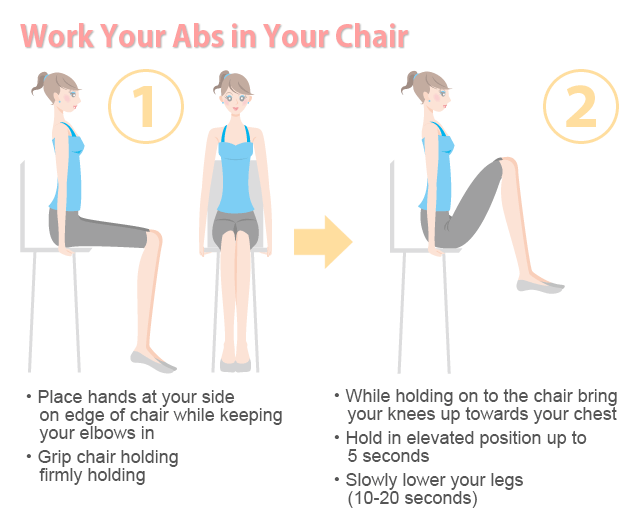
3. Seated ab workout – while sitting at your desk, tighten your abs. Don’t forget to breathe! Hold it for 30 seconds, then rest and repeat. If you twist and hold onto your armrest while doing this, you’ll access your obliques. Option to lift your legs while holding onto the edges of chair – lift for 5 seconds, lower for 10-20 seconds.
4. Kegels – our clinic treats both orthopedic and pelvic floor conditions, and I can’t stress enough how important kegels are to do on a regular basis. Strengthening the pelvic floor prevents incontinence in old age. Just use your next boring meeting or long commute to sneak in a secret workout! Do several sets of 15 repetitions throughout the day, holding for 5-10 seconds each time.
Stretching
1. Wall angels – the perfect way to open up the rounded shoulders and forward head posture that plague every computer user. Remember to keep your spine touching the wall.
2. Forward bends – do them in sitting or standing, reaching forward towards your ankles to stretch out the spine and surrounding muscles. Reach towards one ankle and then the other to stretch out both sides.
3. Calf stretches – our footwear does us no favors, so kick off those heels when you can and stretch out the soles of your feet (plantar fascia) and your calves.
4. Wing pinching – stress and computers make our shoulders creep up towards our ears. Squeezing your shoulder blades by together and down activates those rhomboids and middle/lower traps to help relieve some of that tension.
5. Hip stretch – make your hips and rear happy by crossing one ankle over the other knee, sitting up straight, and then gently leaning forward. Keep the back straight as you begin to feel a stretch in the glutes and hip. You can press down on the knee to deepen the stretch.
PAIN IN THE NECK
My neck aches from looking at my phone, iPad or computer for too long. How do I position myself so this doesn’t happen?
Awareness of your posture is more than half the battle. Most of us sit stooped forward with our necks craned out and down as we look at our devices. Imagine a string on the top of your head that pulls you up, bringing your head to float squarely above your shoulders. Don’t let that string go slack as you start tapping out your next text message, just look down with your eyes or bring your phone up to eye level.
Many of us use our bodies to accommodate to our workspace instead of the other way around. If your computer is off to your left and you spend every day half-turned to the screen, is it any wonder why your back and neck ache on that side? Getting a thorough ergonomic assessment of your workspace by a physical therapist is a simple way to resolve many of those workplace aches.
HUNGRY FOR HEALTH
There’s so much advice out there about what to eat – what are some good foods I should stick to so I can avoid ‘grazing’ or eating on the go?
I spent years of my career working with professional athletes who needed to keep their bodies and minds in top shape for game day. Life in NYC, between the subway stairs, the crowded streets, and the stress of work, also demands a constantly high level of performance from our bodies and our brains. Foods that give your brain the glucose it needs to function will keep you from feeling fatigued and will make you more productive. Most of my clients just mix up a bag to snack on guilt-free throughout the workday. Some brain-food favorites include: walnuts, almonds, grapes, flax seeds, sunflower seeds, sesame seeds, dates, dried cranberries and dark chocolate chips. I also recommend investing in a water bottle that suits your personality and making it a point to drink at least two full bottles every day. Most of us are chronically dehydrated, and though coffee and soft drinks might quench our thirst, they don’t give our cells what they need to function properly. Headaches, fatigue, confusion, dry mouth and dark colored urine can all be signs of dehydration.
THESE SHOES WERE MADE FOR WALKIN’
I love my shoes, but I hate my feet: they hurt so much! How do I change that?
Feet anchor your body to the ground; think of them as your roots. Over time, anything that bothers your feet will have repercussions higher up – in the past decade, I’ve treated many patients with knee, hip, and back problems that stemmed simply from their footwear. It’s only when fashion meets function that you and your body will stay safe. Our feet are unique to the experiences we’ve put them through, and a one-size-fits-all approach to shoes is just asking for trouble. These are some quick tips for buying fashionable shoes:
1. Know your shoe size and width. If you haven’t had it checked in a while, remember that those numbers can change over time! Weight gain, pregnancy, even sports can and will change the structure and size of your foot. Next time you’re at the shoe store, ask the salesperson to properly size your foot.
2. Find out your foot type and mobility. Is your foot rigid? Do you have collapsed arches? Do you claw your toes? Are your ankles wobbly? If you’re in doubt, see a foot specialist to learn more about your foot type.
3. Earn those high heels. Stilettos and narrow wedges might be eye-catching, but they’re also very tough on the tendons and ligaments that surround your ankle, and can result in chronically shortened calf muscles. The stronger your core muscles and your Achilles tendon, the higher of a heel you’ll be able to wear safely. But if they aren’t strong, expect calluses, corns and bunions to follow.
4. If you’re choosing a “do-it-all” shoe – one that you can wear for your commute and during your work day – pick one that has heel support, a spring in the toe box, and a cushion or soft sole to absorb stress.
With improved posture, exercise, increased energy, and shoes that will keep you moving, there’s no excuse not to end summer with a spring in your step. Look out for my talk at WomanCon2014 for a total head-to-toe makeover – physical therapy style!
Renuka Pinto, MPT, PGDR, CSCS, CES

Tuesday, June 24, 2014

Pick The Right Stroller Without Obsessing!


For a new mom picking the right stroller can be overwhelming not to mention expensive. The sales pitch will have you deliberating between strollers of all shapes and sizes.


How do you choose between all the bells and whistles from smart phone to latte holders and various pockets that organize all your needs?

And of course, the price will leave you wondering if you have just been bamboozled. In the process of wanting the very best for our new bundles of joy, our real needs go out the window right along with our money. We forget that the practical aspects of our lifestyles and city living in particular, goes far beyond the new must have stroller or dream accessories.

To help you navigate through the wonderful world of strollers, here are 5 important things to remember when picking the right stroller.


  1. Usage: are you going to use the stroller on public transportation (subway or bus). If so, can you carry the stroller and baby up a flight of subway or bus stairs? Case in point: as much as we would love them to say small, babies get heavier over time and are unable to negotiate stairs until 18 months old.
  2. Ease of folding: can the stroller fold easily with baby in one hand. Remember as women we carry not just the stroller and baby but our pocketbook and/or diaper bag as well. 
  3. Height: if you and your partner have more than 6 inches in height difference does the stroller have adjustable handles.
  4. Footprint: how much space does a folded stroller occupy in closed quarters?
  5.  Maneuverability: can the stroller lock, unlock and make tight turns? Can wheels transition from pavement to grass?

When it comes to picking the right stroller use your heart as well as your head, you can always personalize your stroller to meet your unique style after making the smart functional choice! Need help picking the right products for you? Schedule an appointment for my P3 Method Pregnancy Program and we can do some custom shopping together.

Renuka Pinto, MPT, PGDR, CSCS, CES
Physical Therapist & P3 Pregnancy Program Creator
Duffy & Bracken Physical Therapy