Showing posts with label Manual Therapy. Show all posts

Tuesday, June 17, 2014

Movement Fundamentals


As a physical therapy aide I have witnessed many amazing recoveries and learned more exercises than ever imagined. Manual therapy is only half the battle toward eliminating weaknesses and rebuilding strength. Individualized exercise programs allow patients to be involved in their recovery, by not only re-gaining their range of motion but also their confidence. Patients discover their limits through exercise; and with assurance begin to push those limits. They also learn the importance of self-motivation, which can make for a gradual, yet positive recovery. It is especially important to your overall recovery that your individualized exercise program is followed because it helps your therapist to see your progress. This plays a role in whether your program is modified or kept the same.

For me, these exercise programs have served as a platform for learning. There is no one exercise that serves one purpose; they can be used for the affected area directly and indirectly. I can have two charts in my hand with the same exercises but chances are they will be for two different body parts. My job doesn’t just involve watching, it also includes engaging, correcting, explaining and reassuring the patient that it will be beneficial to their recovery.

Since being at Duffy & Bracken I have been given the opportunity to extend my dance knowledge. During my studies as a dance major I learned invaluable techniques for maintaining my flexibility and strength. No, I can’t twist into a pretzel or lift my leg all the way to my face, but who wants that anyway! The lessons I learned have helped me maintain a healthy balance of strength and flexibility. Here are a few dance techniques that I have been able to incorporate into some of our patients exercise plan.

These are considered basic foundations of movement, yet it can be difficult for some to execute.

X-Roll: Begin lying down on a flat and firm surface in an X shape. KEY 1: Everything is relaxed! Next, allow the right (or left) fingertips to lead the arm across the front of the body diagonally up to the left side, allowing the back to spiral. KEY 2: Nothing else except the arm and back should be moving at this point! Continuing this path, you engage the abdominal muscles, which will assist you in rolling over onto your stomach. KEY 3: Your legs are just coming along for the ride, leave them be! THINK: I’m Melting! You want your body to “melt” into the floor as you roll all the way onto your stomach, circling the opposite arm above the head so that you may create another X shape. To go back, refer to KEY 1, except you are leading with right (or left) toes! This time everything above the legs follows behind. 
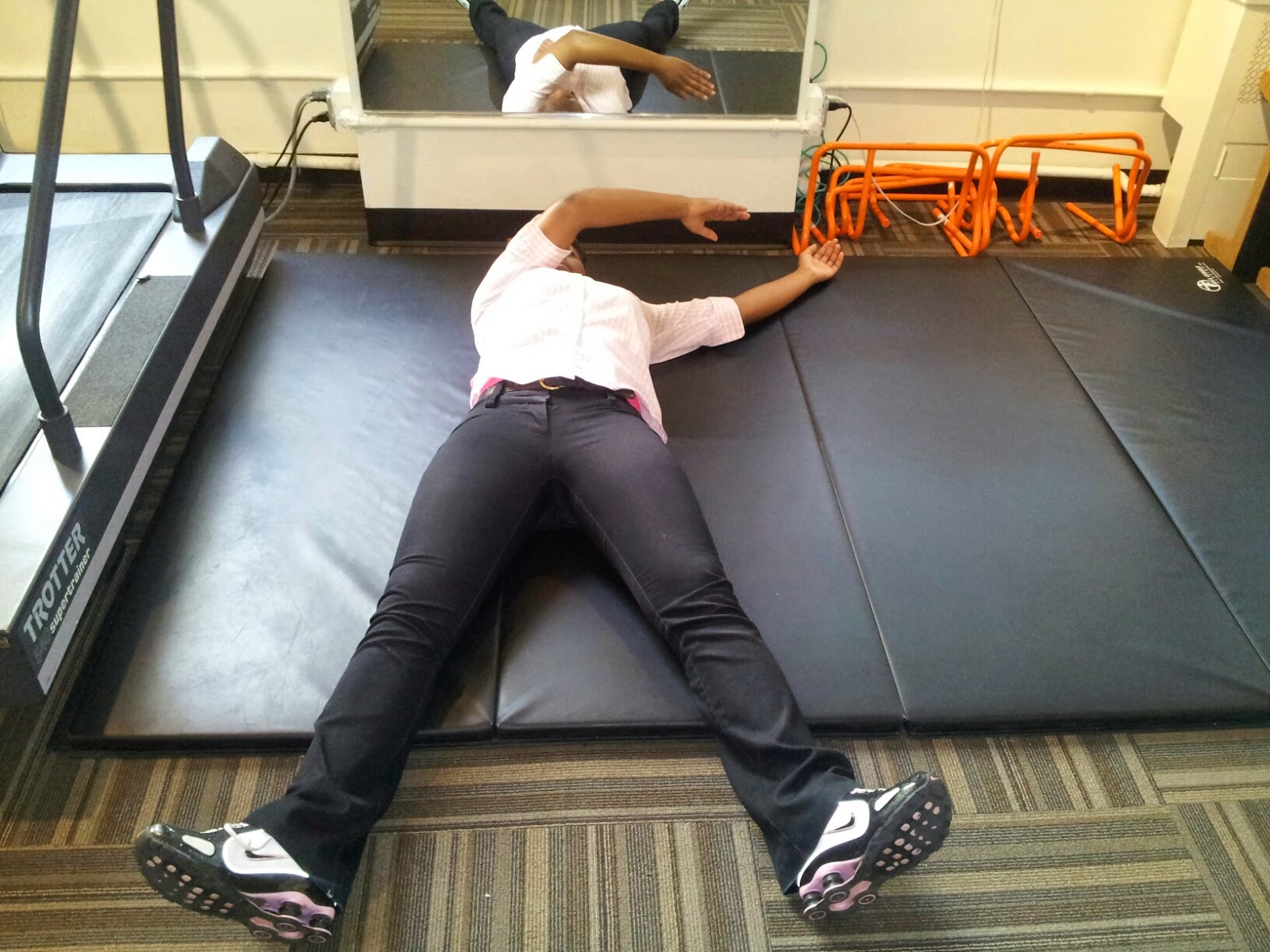


Body Half: Again begin in a relaxed X shape. In this position we want to initiate movement from the head, elbow and knee of the same side. Head and elbow moves down as the knee moves up, creating a side bend. KEY 1: The opposite side is completely relaxed! To return to the X shape we simply initiate with the fingers, top of the head and toes to stretch back out. Simple enough right? Now give it a try on the other side!
Exercises from Bartenieff Fundamentals an extension of Laban Movement Analysis


Head Tail: Begin in a seated position on the floor with the legs outstretched in front of you. Legs and arms are relaxed, but the back is straight. Initiating from the top of the head, allow the head to drop to the side (Think: ear to shoulder). KEY 1: Do not control the head drop! Allow the full weight of the head to bring the torso along for the ride. Before hitting the mat, quickly catch yourself with your hands and push back up, creating a rebound. Now repeat on the left.  The goal of this exercise is to increase spinal mobility as well as learning to weight shift. By relaxing the head and spine you allow for more range of motion to be met while doing this exercise. 

These movements are as effortless as rolling out of bed (literally), but with limitations it can be taxing on the body. It is for that reason we stress the importance of exercise during AND after recovery. Listen to your body! An exercise program loses its effectiveness if you fly through it. Understand and continue to internalize the “kinks” that you may notice. If you are still in PT let your therapist know and together changes can be made. If you’re a past patient call us to schedule a Functional Movement Screen (FMS) so we can prescribe an exercise plan for you to keep you active and pain free.  

Brittany Wilson
Duffy & Bracken PT Aide

Saturday, April 26, 2014

P3 Pregnancy Program: Don't Become A Statistic!


P3 is a program I developed after my first pregnancy to help women achieve their full potential as moms to be and new moms!


Let's back track a few years, after I gave up my stint with the sports world where I spend almost a decade of my career......and settled into my current Downtown NYC clinic!


Every day we saw women for pregnancy related headaches, shoulder, back and knee pain and then two years later I found myself pregnant...... and I decided "NOT ME", I'm not becoming a statistic.


So the P3 pregnancy program was born four months after the birth of my first child and of course I repeated the program again when I had my second.  


So come along with me on this journey through my blog where I will share tips, secrets, and honest truths plus teach you how to have the best pregnancy journey ever!  


Stay tuned and check out an overview of the program below.

Renuka Pinto, MPT, PGDR, CSCS, CES


The P3 Method: Plan, Prepare, Prevent
The P3 Method is tailored to your particular needs and is even covered by some health insurance plans. The class is held by appointment only, and can be scheduled at your convenience.

Your custom program may include the following:

MANUAL THERAPY
One-on-one, hands-on approach to address musculoskeletal changes

PELVIC MUSCLE RE-EDUCATION
A technique that uses computerized equipment to measure baseline pelvic floor strength at onset of pregnancy and then re-train pelvic floor post delivery


PELVIC FLOOR EDUCATION
Kegel and breathing techniques to facilitate integrity of pelvic floor

POSTURAL RE-EDUCATION AND MOVEMENT TECHNIQUE
A visual and proprioceptive feedback is utilized to adapt to bodily changes
 
STRENGTH BUILDING
GRAVITY small-group personal training is a non-impact tool to help build muscle strength and cardio efficiency

CUSTOM SHOPPING
Individualized education on baby products in relation to your body type and muscle strength (e.g. sling versus carrier)

BABY TRAINING
Specific stretches and strengthening exercises to prevent post-delivery musculoskeletal breakdown when caring for your newborn

GETTING YOUR BODY BACK
Post-delivery exercise program to get back to your pre-pregnancy weight

Q&A
Tips on how, what, when, and where while pregnant, immediately postpartum, and post-labor
© Total Gym

Tuesday, February 12, 2013

NO PAIN, NO GAIN!


My Duffy & Bracken Physical Therapy one year Anniversary is fast approaching. As the PR & Marketing Director, I wear multiple hats but one hat I didn't see coming was that of (wait for it) ....PATIENT. You see while finishing my Masters Degree, I worked from home for three years. As you can imagine, when I started commuting to Downtown NYC to work and began moving around more and more, I started feeling all sorts of aches and pains in my body. Even though I went to the gym when I could and got a work out in here or there....my mental activity certainly didn't make up for all my physical inactivity.
I figured how convenient for me....I work at a physical therapy clinic so I could just get a quick fix and be on my way. Boy was I wrong...TOTALLY wrong.
Many of you will want to argue with me that the 'No Pain, No Gain' philosophy is actually a myth and pain is not required to have a quality workout. Trust me I get! But I'm not here to argue that point....the truth is that Physical Therapy is unlike any other visit to your doctor's office. It most times will require more than just the quick fix even I expected. Like everyone else I was going to have to put in the work if I wanted to be pain free.
Here is what I learned while walking a mile in your shoes as a PT patient:
1. It may pain you to have manual therapy. Physical Therapy is not like getting a massage at your neighborhood spa. Manual therapy techniques are not as relaxing, it can even be uncomfortable, but trust your therapist to be your guide to long term freedom from pain.
2. It will pain you to do your exercises everyday. No one likes to do them but they are an integral part of your treatment plan....don't neglect them. And if you ever find yourself in pain again after being discharged, the first question you should ask yourself is ...have I been doing my home exercise program.... then make an appointment.
3. It will pain you to carve out a couple of hours a week for 4-6 weeks. Having been in your position, I definitely understand how difficult it can be to make time for treatment. We know your busy but don't be what I like to call a 'Repeat Offender'. Repeat offenders are patients who start feeling better in the middle of their treatment and decide that they don't need therapy anymore. They end up back in therapy because they didn't commit to the process. Would you tell your cardiologist that you don't need your heart medication anymore?
4. It may pain you to dip into your pockets for those co-pays at every visit. Yes, we know it adds up but we didn't make the rules we just enforce them. If you think about it...can we really place a price tag on being pain free and able to live your life to its fullest without physical limitations.
Anyone who has successfully completed their PT treatment plan will tell you that the benefits far out weigh the costs. When it comes to PT...No Pain, No Gain! So yes, it may be a pain in one way or another but most things worth doing are usually not easy. If you are currently in a PT treatment plan, commit to it and if your living in pain, you don't have to....make an appointment today!
Kieffer Pearce
PR & Marketing Director

Wednesday, November 7, 2012

Massage Junkies


Before being a physical therapist (PT), I was a licensed massage therapist for 13 years. In that time, I discovered what an amazing tool massage is in relieving pain, lowering stress levels, facilitating length in muscles and, in general, giving back to a person a deep sense of health and human connection....Temporarily.
That is the key-word -- TEMPORARILY. 
Massage can be a powerful ally in PT, but because it is a passive therapy, the person receiving the massage is reliant on someone else's hands and elbows to give them relief. The analogy would be, the massage therapist is the guy with the bucket in a boat trying to unload the boat from taking on water, whereas in physical therapy, the PT, through therapeutic exercise and patient education gives the patient the rudder of the boat and shows the patient how to steer her/himself out of troubled waters.
In other words, the PT empowers patients by giving them knowledge to help themselves so that when they are on their own, they can continue to take care of themselves. That is altruism at its best, which is one of the reasons why as a massage therapist, I wanted to graduate to become a physical therapist. The beauty of this is that the PT and the patient become 'A TEAM' that works together in achieving the patients' goals.
This brings me to you --- our dear patients at Duffy & Bracken and the topic of massage. Duffy and Bracken is a manual clinic, which means that we specialize in hands on techniques. It would be easy to falsely assume that because we are manual PT's, that we perform a lot of massage when we treat you. Manual therapy actually means that the PT, through their hands and eyes, assess and diagnose a patient.
From that assessment, we choose what would most help you, which may or may not include massage. So what this means to you as the patient and team member in your re-hab, is to resist thinking that the massage is the centerpiece of your session. We realize how difficult it is when massage can feel so good, but think long-term. Would you rather have the quick temporary fix, or would you rather invest long-term and actually address the real reason why you came to physical therapy in the first place? (Please answer, "yes" to the latter!)
Also trust your therapist if he or she one day decides not to do massage. Your PT may have decided that massage would actually make your symptoms worse. In general, we do indeed encourage you to seek out a good massage therapist to act as an ally in your rehab. We can always refer you to one if you are unsure of where to look. In fact, we offer massages on Tuesdays and Fridays here at Duffy and Bracken. In the meantime, we ask you to not become a Massage Junkie and sell your PT short of their skills by thinking that all you should be doing at PT is lying down on the table to get the "rub".

John Howard (Johann), DPT, LMT